
In the rapidly evolving renewable energy landscape, the solar tracking system has emerged as a transformative technology for commercial enterprises seeking to maximize energy yield and optimize return on investment. Unlike fixed-tilt installations, a commercial solar tracker dynamically adjusts panel orientation to follow the sun’s path, delivering energy gains of 15–40% depending on configuration and geography. This article explores the dominant commercial applications of solar tracking technology, examines representative case studies, and unpacks the structural and functional design principles that define modern tracker architecture.
Dominant Commercial Applications
The global commercial and industrial solar tracker market is projected to reach approximately USD 13.5 billion by 2034, growing at a CAGR of 9.2% from 2025 to 2034, with Asia Pacific commanding a 41.8% market share. Within this expansive market, three primary application segments dominate: utility-scale ground mounts, commercial rooftop installations, and off-grid industrial power systems.
Utility-scale projects represent the largest deployment category, capturing 48.1% of the commercial and industrial solar tracker market. These large-scale solar farms—often exceeding 50 MW—serve factories, corporate campuses, and grid-level power supply contracts. For instance, Trina Solar secured supply agreements with ACWA Power in January 2026 to deliver solar PV trackers for projects including a 1.5 GW installation in Saudi Arabia, demonstrating how tracker technology scales to gigawatt-level commercial commitments. In these environments, even marginal efficiency improvements translate into massive energy gains across vast land footprints, making single-axis and dual-axis trackers economically indispensable.
Commercial rooftop and ground-mount installations constitute the second major segment. These systems directly power manufacturing facilities, logistics warehouses, data centers, and retail chains. Companies like Sedgeley Solar Group and Radial Power have raised $60 million and $80 million respectively to expand commercial and industrial solar portfolios, reflecting strong institutional confidence in tracker-enhanced distributed generation. For energy-intensive industries, the enhanced output from a solar tracking system directly reduces operating costs and stabilizes long-term electricity expenses.
Off-grid and hybrid applications represent the fastest-growing segment, particularly in remote industrial sites where grid infrastructure is costly or impractical. Mining operations, agricultural processing facilities, and remote construction sites increasingly deploy tracker systems paired with battery storage to ensure reliable power supply independent of utility networks.
Representative Case Studies and Structural Adaptations

Case Study 1: Horizontal Single-Axis Tracker for Dense Commercial Arrays
A widely deployed commercial solution is the horizontal single-axis tracker (HSAT), engineered specifically for ground-mount solar farms and utility-scale PV installations. These systems rotate panels along a north-south axis, tracking the sun from east to west throughout the day. Modern HSAT designs incorporate astronomical tracking algorithms that calculate precise sun positioning, combined with backtracking algorithms that prevent inter-row shading in dense panel configurations—a critical feature for maximizing land-use efficiency in commercial projects.
Structurally, these trackers utilize Q235 steel with hot-dip galvanizing to withstand decades of severe outdoor exposure. They are engineered to operate across extreme temperature ranges from -40°C to +70°C and feature automatic wind-stow mechanisms that flatten panels when gusts threaten structural integrity. With IP65 protection and ≤1° tracking accuracy, these systems achieve system lifespans exceeding 25 years while maintaining minimal maintenance requirements. The RS485-MODBUS communication interface enables remote monitoring and control, allowing facility managers to oversee tracker performance across distributed commercial portfolios from centralized operations centers.
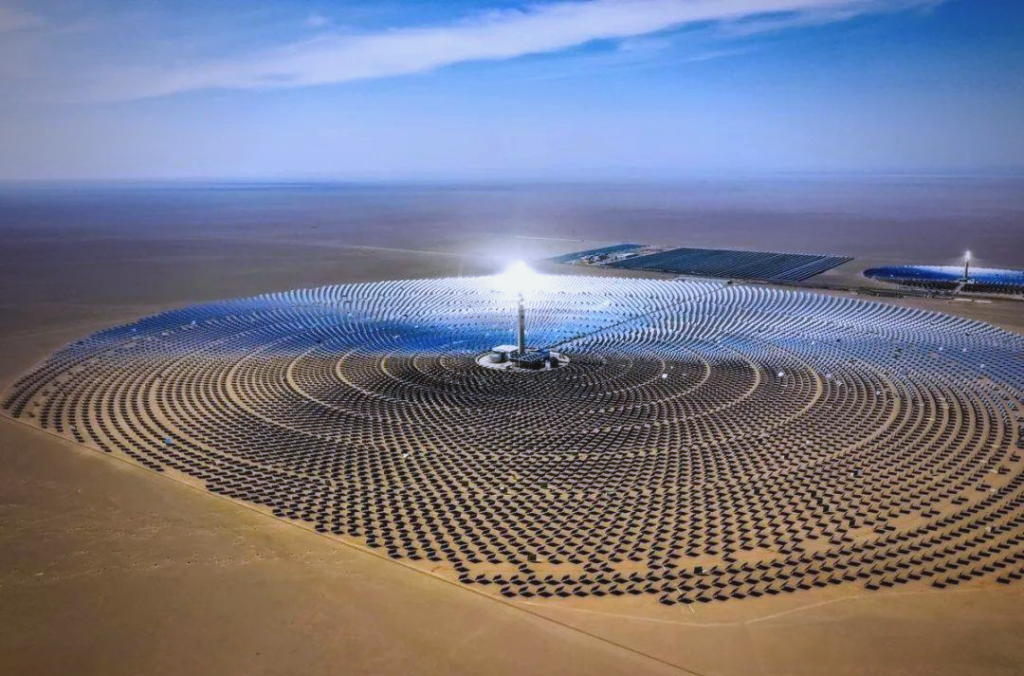
Case Study 2: High-Precision Dual-Axis Systems for Concentrating Applications
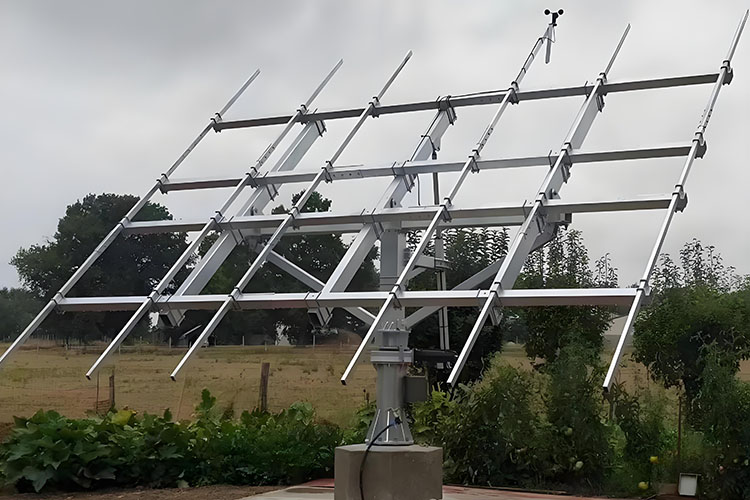
For commercial applications requiring maximum energy density—such as concentrating photovoltaic (CPV) and concentrating solar power (CSP) systems—dual-axis trackers provide both azimuth (horizontal) and zenith (vertical) orientation control. A research-grade dual-axis tracker developed for pre-commercial CPV deployment demonstrates the precision achievable in modern commercial designs.
This system employs a vertical pedestal-mounted slew drive with a 62:1 worm gear ratio coupled to 24V DC motoreductors achieving a total gear reduction of 14,632:1. This extreme reduction ratio ensures positional holding without energy consumption when motors are de-energized, while enabling precise angular adjustments. The structure supports a 4 m² steel frame anchored to reinforced concrete footings (60×50×50 cm), providing the stability necessary for high-precision tracking. Four limit switches prevent mechanical overtravel, and the system achieves tracking accuracy below 0.4° under clear-sky conditions—sufficient to maintain CPV conversion efficiencies above 90%.
The energy analysis of this precision tracker demonstrated a 37.5% increase in generation compared to fixed systems, validating the economic case for dual-axis deployment in high-value commercial applications where land costs or energy prices justify the additional capital expenditure.
Case Study 3: Modular Commercial Trackers for Distributed Industrial Generation
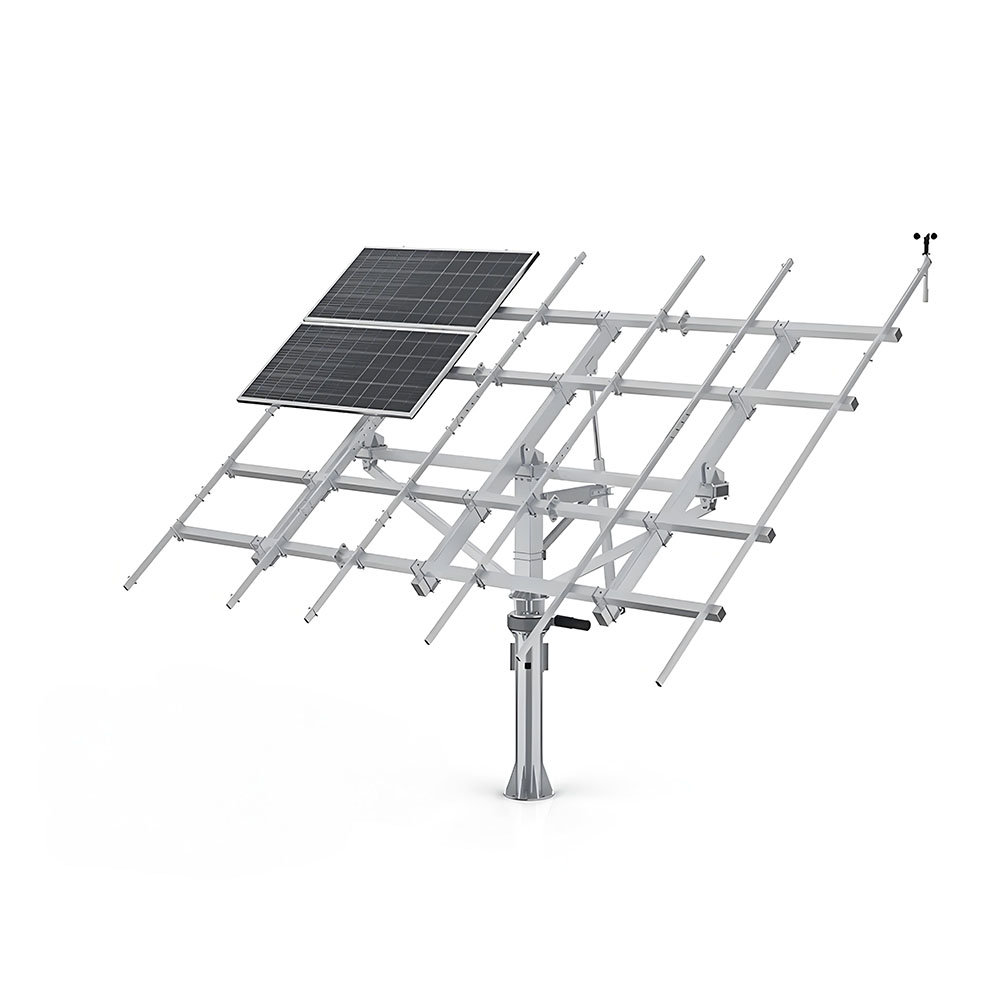
The SolPath commercial tracker series exemplifies the modular approach dominating contemporary commercial installations. These systems accommodate configurations ranging from 4-7 kW residential-commercial hybrids to 40-panel heavy-duty dual-axis arrays for industrial solar farms. Single-axis variants in this category deliver up to 30% yield increases over fixed mounts, while dual-axis systems unlock 20–40% additional generation by tracking both solar azimuth and elevation angles.
These modular systems emphasize smart algorithm integration with GPS positioning for automatic sun tracking, eliminating the need for complex site calibration. The ruggedized design targets 25+ year operational lifespans, with sealed drive mechanisms and corrosion-resistant materials ensuring reliability across diverse climatic conditions—from humid subtropical manufacturing zones to arid desert solar fields.
Functional Architecture and Design Philosophy
The design philosophy underlying modern commercial solar tracker systems balances three competing imperatives: maximizing energy yield, minimizing levelized cost of energy (LCOE), and ensuring mechanical reliability across 25–35 year operational lifespans.
Structural Engineering Principles
Commercial tracker structures must resolve fundamental mechanical tensions. Vertical pedestal designs (VPDAT) transfer structural loads efficiently to ground foundations but exhibit susceptibility to wind-induced overturning moments. Horizontal primary axis designs (HPDAT) distribute loads differently but introduce gravity-induced bending challenges. Contemporary commercial designs increasingly adopt torque-tube architectures with distributed bearing points, reducing material stress while enabling longer tracker rows that reduce foundation costs per watt.
Steel selection represents a critical design decision. Q235 structural steel with hot-dip galvanizing (typically 80–120 μm zinc coating) provides the corrosion resistance necessary for coastal or high-humidity industrial environments while maintaining cost competitiveness. For premium installations in extreme climates, aluminum alloys or stainless-steel components may substitute critical elements, though at higher material cost.
Drive and Control Systems
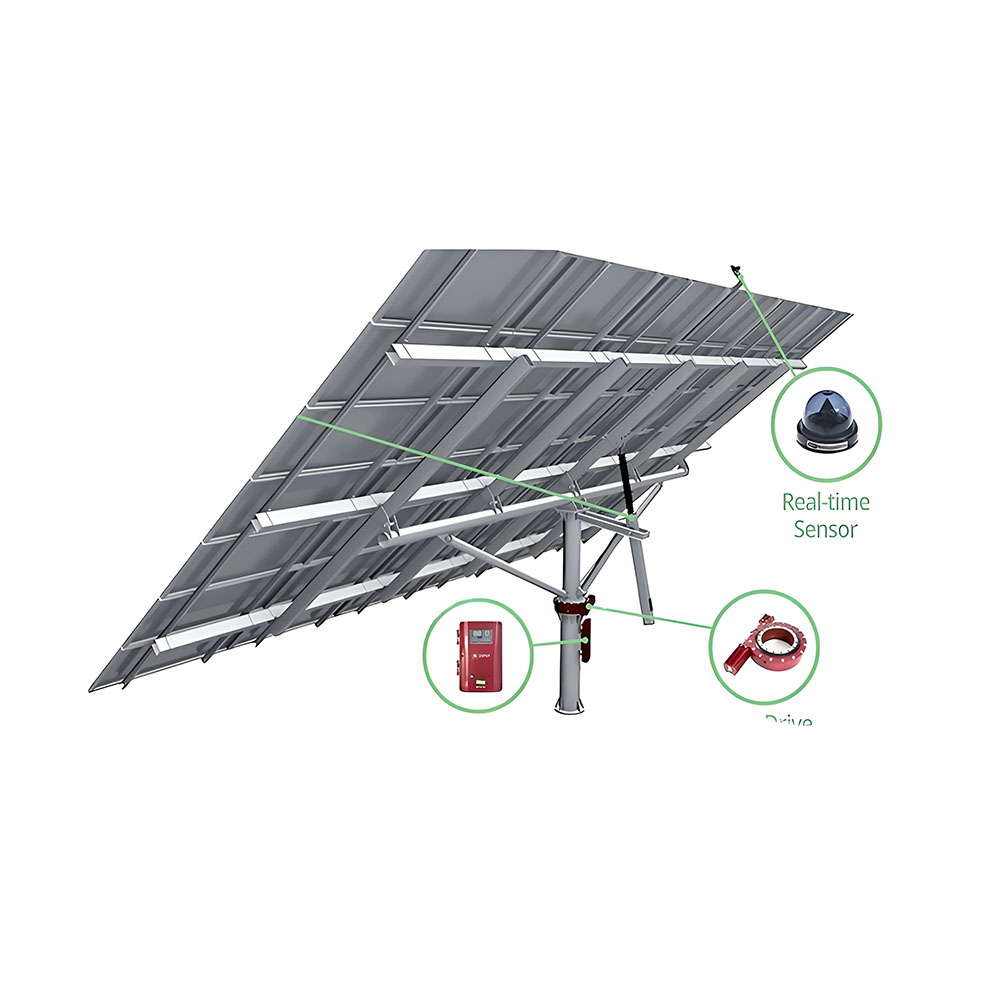
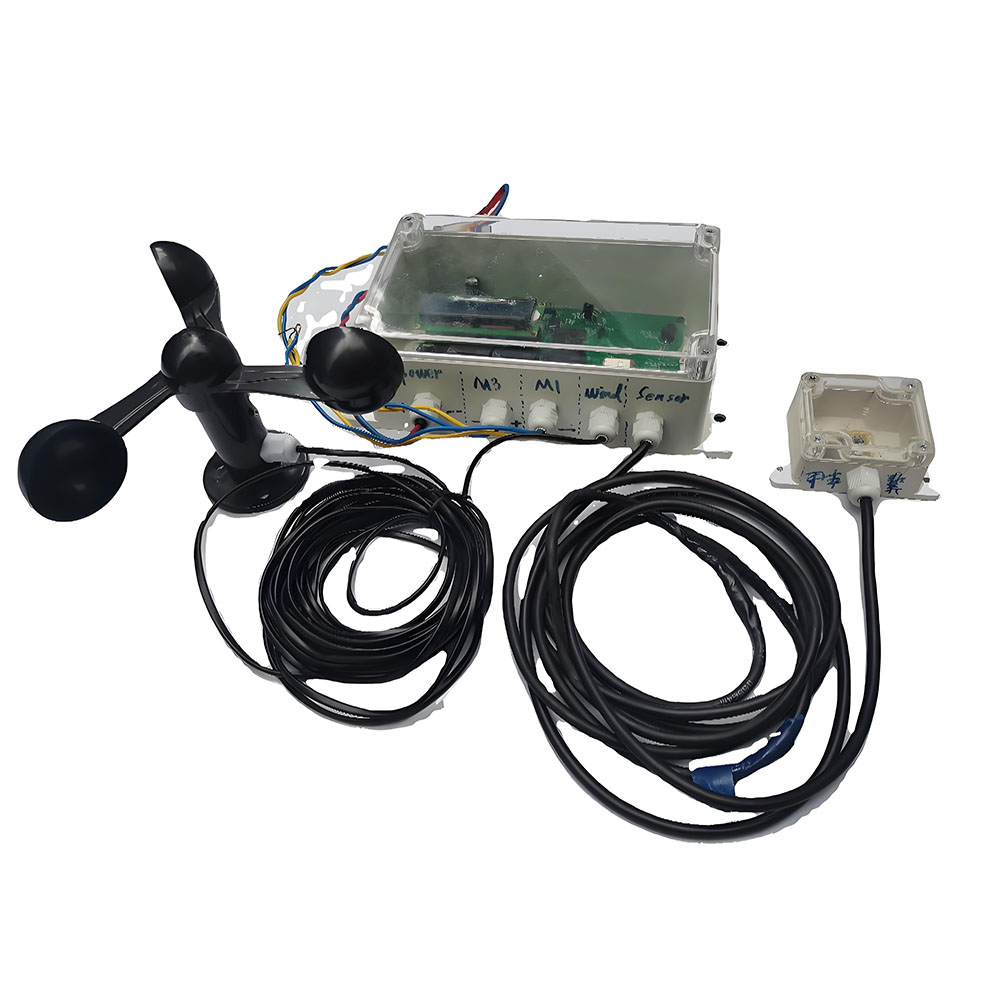
The drive mechanism constitutes the core functional differentiator between tracker classes. Active tracking systems—dominating 69.2% of the commercial market—employ motorized drives with astronomical or sensor-based control algorithms. These systems offer superior precision and adaptability, adjusting to seasonal sun-path variations and responding to weather conditions through integrated wind sensors and rain detection.
Passive trackers, relying on thermal expansion or gravitational counterbalance, occupy a niche in cost-sensitive applications but lack the precision and wind-stow capabilities essential for large commercial installations. The control architecture typically integrates GPS modules for astronomical positioning, encoders for positional feedback, and wireless or RS485-MODBUS communication for SCADA integration.
Economic Design Considerations
From a financial perspective, tracker systems add approximately $0.04–$0.10 per watt in upfront capital cost compared to fixed-tilt mounting, representing an 8–15% increase in balance-of-system expenses. For a 100 MW commercial installation, this translates to an additional $4–$10 million investment. However, the enhanced generation profile—particularly the extended morning and late-afternoon production windows—improves revenue capture during peak pricing periods. In high-irradiance markets with favorable electricity pricing, tracker systems typically achieve economic payback within 5–8 years, after which the additional energy production compounds as long-term revenue advantage.
The integration of battery storage further strengthens the tracker value proposition. Tracker systems produce flatter, more distributed generation profiles throughout the day compared to fixed-tilt arrays, improving battery charging efficiency and reducing inverter clipping during midday peaks. For commercial solar-plus-storage projects, this operational flexibility enhances dispatch optimization and grid support capabilities.
Any way
The solar tracking system has transitioned from experimental technology to standard commercial infrastructure across utility-scale, distributed industrial, and off-grid applications. Whether through the proven economics of horizontal single-axis trackers in large solar farms, the precision engineering of dual-axis systems for concentrating applications, or the modular adaptability of distributed commercial units, tracker technology delivers measurable energy gains that justify capital investment in appropriate commercial contexts.
As the commercial and industrial solar tracker market advances toward USD 13.5 billion by 2034, design evolution continues to focus on structural durability, intelligent control integration, and LCOE reduction. For commercial enterprises evaluating solar investments, the question is no longer whether tracking technology works, but rather which tracker architecture—single-axis or dual-axis, centralized or distributed, passive or active—best aligns with specific energy yield targets, site conditions, and financial return requirements.