
As global energy demand shifts toward sustainable solutions, solar tracking technology has emerged as one of the most effective methods to maximize photovoltaic (PV) system efficiency. By continuously orienting solar panels toward the sun, trackers can significantly increase energy yield compared to fixed-tilt installations. Solar tracking systems are broadly classified into two categories: the passive solar tracker and the active solar tracker. Although both serve the same fundamental purpose, they differ dramatically in structural design, operating principles, cost profiles, and ideal use cases.
Пассивный Солнечный Трекер: Structure and Mechanism
A passive solar tracker is an elegantly simple mechanical device that requires no external electrical power, motors, sensors, or control electronics. Its structure typically consists of a solar panel mounted on a pivoting frame, balanced by thermal actuators positioned on opposite sides of the array.
The most prevalent mechanism relies on low-boiling-point refrigerant fluids or compressed gases sealed inside cylindrical canisters. As sunlight strikes one side of the tracker, the fluid in the exposed canister heats up, vaporizes, and expands—creating a pressure differential or weight imbalance that causes the panel to tilt toward the sun. Shadow plates ensure that only one canister receives direct sunlight at a time, maintaining the directional bias. Alternative designs employ shape-memory alloys, bimetallic strips, or buoyancy-driven guide-slot mechanisms, all of which convert thermal energy directly into mechanical rotation without any electrical intermediaries.
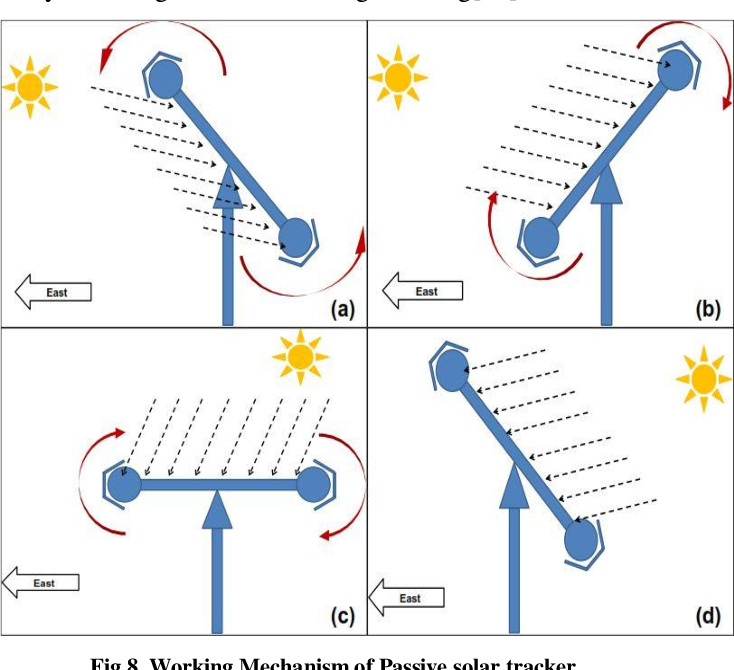
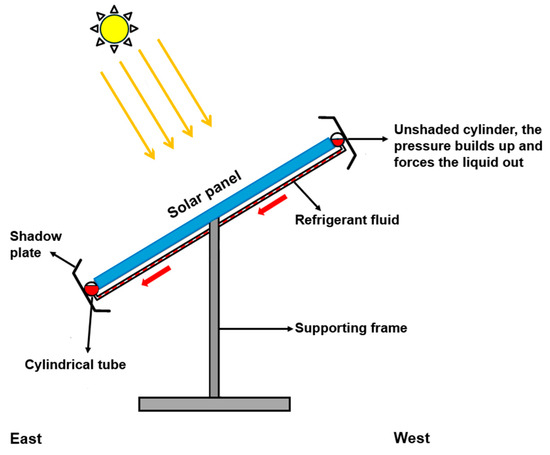
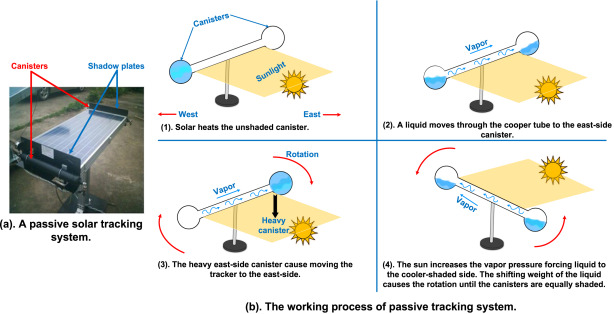
Figure 1: Working mechanism of a passive solar tracker using thermal expansion of refrigerant fluid and shadow plates to create directional bias.
This structural minimalism makes the passive solar tracker exceptionally reliable. With no motors to wear out and no circuits to fail, these systems can operate for years with virtually zero maintenance.
Active Solar Tracker: Structure and Mechanism
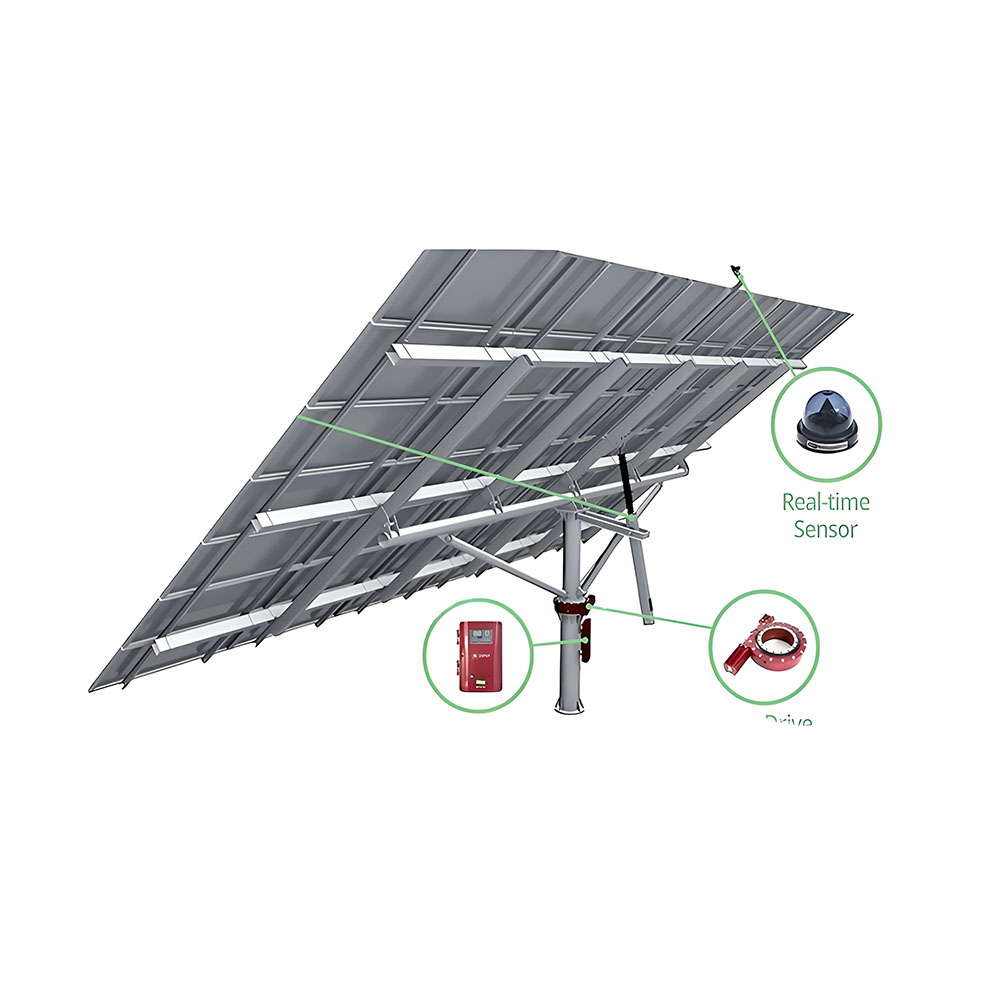
In contrast, an active solar tracker is a sophisticated electromechanical system designed for precision and real-time responsiveness. Its structure encompasses electric motors (stepper or servo motors), light-dependent resistor (LDR) sensors or photodiodes, a microcontroller or PLC (Programmable Logic Controller), motor drivers, and a robust mechanical drive train including gears, torque tubes, and slewing bearings.
The operating principle of an active solar tracker is feedback-driven automation. Optical sensors detect the sun’s position and transmit signals to the controller, which calculates the optimal azimuth and elevation angles and commands the motors to execute precise adjustments. Advanced systems may incorporate GPS modules and astronomical algorithms to predict the sun’s trajectory, enabling tracking accuracy within ±0.5 degrees. Single-axis active trackers rotate panels along one horizontal axis (east-west), while dual-axis systems adjust both azimuth and tilt to follow the sun’s seasonal elevation changes.
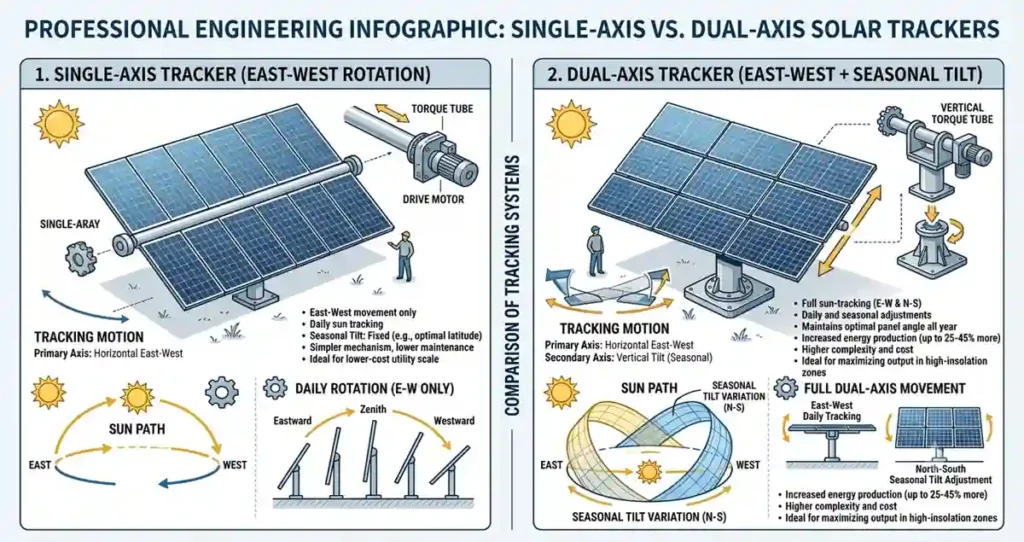
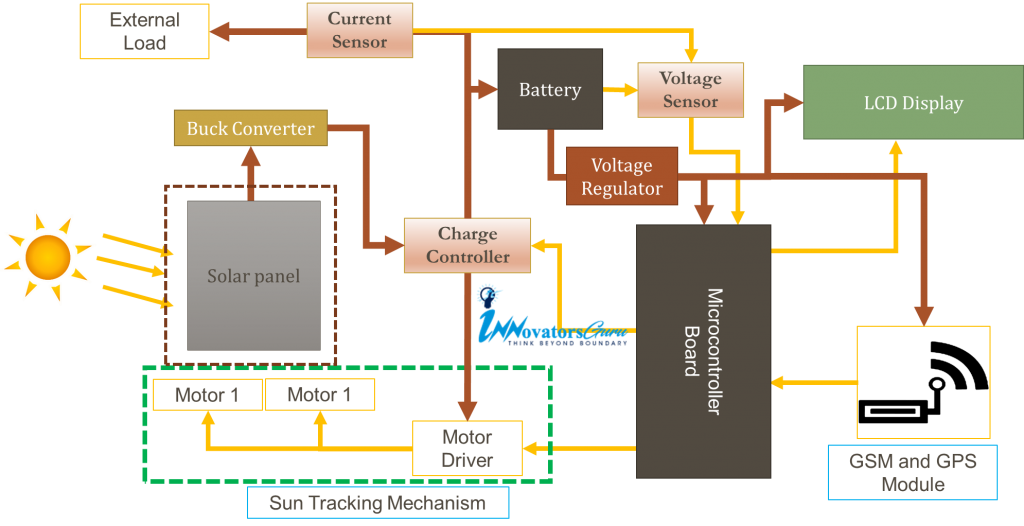
Figure 2: Active solar tracker circuit diagram and system architecture showing sensors, microcontroller, motor drivers, and mechanical drive components.
Comparative Analysis: Structure and Principle
| Особенность | Пассивный Солнечный Трекер | Активный Солнечный Трекер |
|---|---|---|
| Drive Mechanism | Thermal expansion, gravity, buoyancy | Electric motors, gears, actuators |
| Power Requirement | Zero external power | Requires electrical supply |
| Система управления | None (purely physical) | Microcontroller/PLC with sensors |
| Tracking Accuracy | Moderate (thermal lag) | High (±0.5° precision) |
| Response Speed | Slow (minutes to adjust) | Instantaneous |
| Mechanical Complexity | Очень низкий | Высокий |
| Потребности в обслуживании | Минимальный | Regular servicing required |
| Первоначальная Стоимость | Низкий | Высокий |
Application Scenarios
The divergent characteristics of these systems naturally dictate their optimal deployment environments.
Passive solar trackers excel in small-scale, off-grid, and resource-constrained settings. They are ideal for residential rooftop systems under 10 kW, agricultural water pumping stations in remote areas, and rural electrification projects in developing regions where technical expertise and maintenance infrastructure are limited. Their independence from electrical power makes them particularly valuable in locations with unreliable grid access.
Active solar trackers dominate commercial, industrial, and utility-scale solar farms. Any installation exceeding 10 kW—especially large ground-mounted arrays and concentrated solar power (CSP) plants—benefits substantially from the precision of active tracking. These systems are essential for concentrated photovoltaics (CPV), where even minor misalignment causes severe efficiency losses. Additionally, active trackers perform better in climates with intermittent cloud cover, as their rapid response capabilities allow immediate repositioning once sunlight returns.
Advantages and Disadvantages
Пассивный Солнечный Трекер
Преимущества:
- Zero energy consumption: Completely autonomous operation with no parasitic power draw.
- Ultra-low maintenance: No motors, electronics, or gears to fail; highly resistant to dust and extreme weather.
- Low capital cost: Simple construction allows for affordable deployment, often using recycled materials.
- High durability: Fewer moving parts translate to longer operational lifespans.
Disadvantages:
- Thermal lag: Response time is slow because heating the actuator fluid takes time.
- Weather dependency: Performance drops in cold or overcast conditions where insufficient heat is generated.
- Limited load capacity: Not suitable for large or heavy panel arrays.
- Lower precision: Inadequate for CPV applications requiring exact sun alignment.
Активный Солнечный Трекер
Преимущества:
- Superior precision: Real-time tracking maximizes irradiance capture, typically increasing annual energy yield by 25–45%.
- Dual-axis capability: Can track both azimuth and elevation for year-round optimization.
- Scalability: Supports large, heavy arrays across extensive solar farms.
- Rapid adjustment: Immediate response to changing sun position and weather conditions.
Disadvantages:
- High costs: Motors, controllers, sensors, and drive trains increase both CAPEX and OPEX.
- Energy consumption: The tracking system itself consumes electricity, marginally offsetting gains.
- Mechanical wear: Complex systems require regular maintenance and are vulnerable to wind damage.
- Technical dependency: Installation and servicing demand skilled technicians.
Заключение
Choosing between a passive solar tracker and an active solar tracker ultimately depends on project scale, budget constraints, climate conditions, and maintenance capabilities. The passive solar tracker offers an elegant, zero-energy, maintenance-free solution ideal for small-scale and off-grid applications where simplicity trumps precision. Conversely, the active solar tracker remains the industry standard for large-scale commercial and utility projects where maximum energy yield and precise sun tracking justify the higher investment. By understanding these structural and operational distinctions, solar developers can select the optimal tracking strategy to maximize both energy production and economic returns in their specific contexts.