
In the rapidly evolving landscape of renewable energy, single axis solar trackers have emerged as a proven technology to maximize photovoltaic energy yield. Among the various tracker configurations, the azimuth angle система слежения—also known as the vertical single-axis tracker—offers a unique mechanical approach that rotates solar panels around a vertical axis to follow the sun’s daily east-to-west path. This article provides a comprehensive technical overview of azimuth-only single axis trackers, covering their structural design, control methodology, and specific industry examples.
Structural Design and Mechanical Principles
An azimuth angle single axis tracker fundamentally differs from the more common horizontal single-axis tracker. While horizontal trackers rotate around a north-south aligned horizontal axis to change panel tilt throughout the day, azimuth-only trackers rotate the entire panel assembly around a vertical axis, much like a weather vane following wind direction. This configuration allows the solar array to sweep through the full 360-degree compass range, directly addressing the sun’s changing azimuth angle from sunrise to sunset.
The structural system comprises four core components:
1. Foundation and Vertical Pylon: A robust steel or concrete pylon anchored to the ground provides the primary vertical axis. This pylon must withstand both the dead weight of the panel array and dynamic wind loads transmitted through the rotating structure.
2. Azimuth Rotation Mechanism: At the top of the pylon, a slewing bearing or rotary drive assembly enables smooth horizontal rotation. In many designs, a worm gear and worm wheel mechanism is employed because it offers self-locking characteristics—preventing the tracker from rotating under wind forces when the motor is inactive.
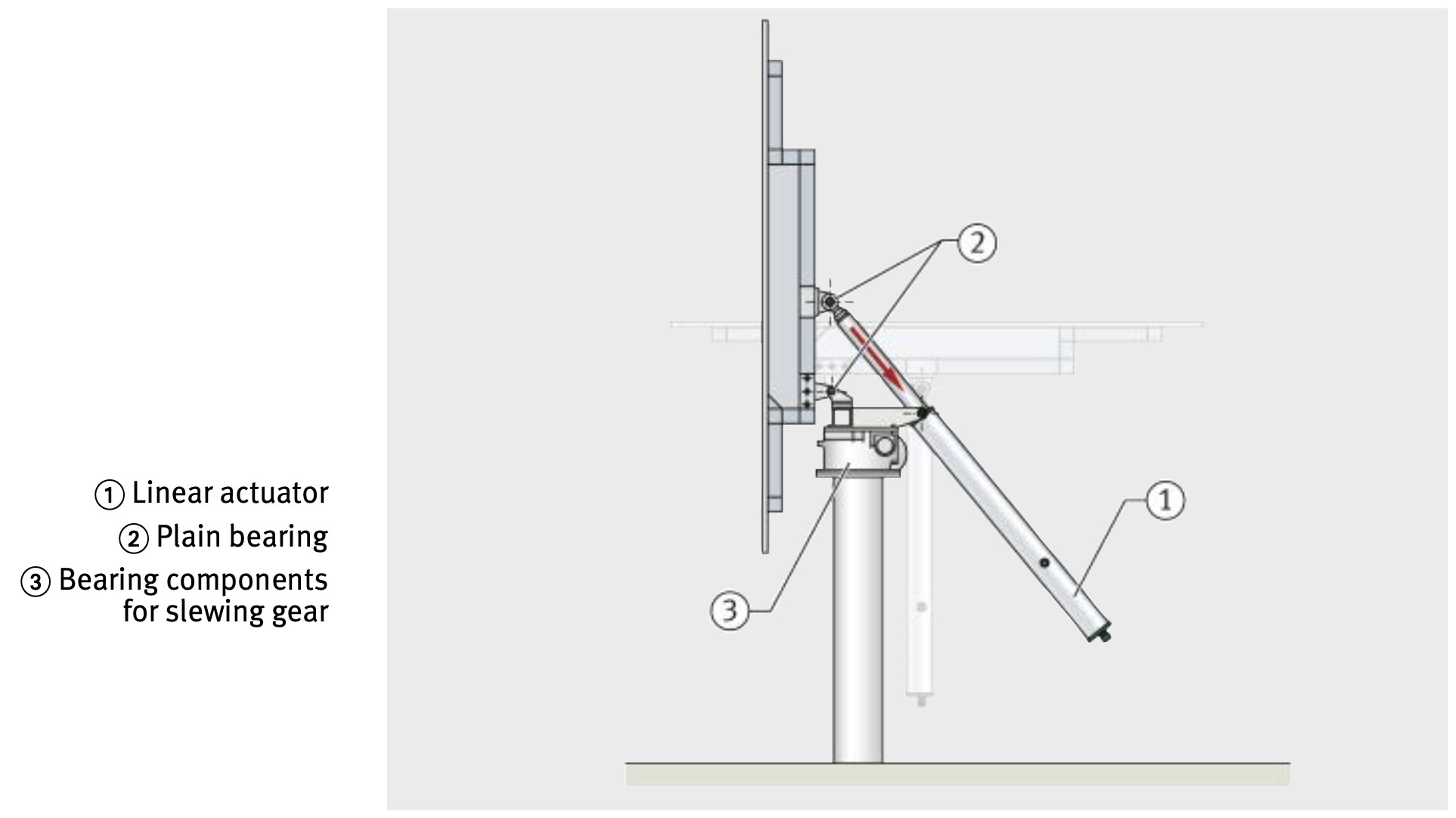
3. Panel Mounting Frame: The torque tube or mounting frame extends horizontally from the rotation mechanism, carrying multiple photovoltaic modules in portrait or landscape orientation. The frame is engineered to maintain structural rigidity across long rows while minimizing torsional deflection.
4. Drive System: A DC motor, stepper motor, or AC motor paired with a high-ratio gearbox (often 40:1 or higher) provides the precise rotational force. Linear actuators may also be integrated in certain patented designs to push or pull the array through its azimuth arc.
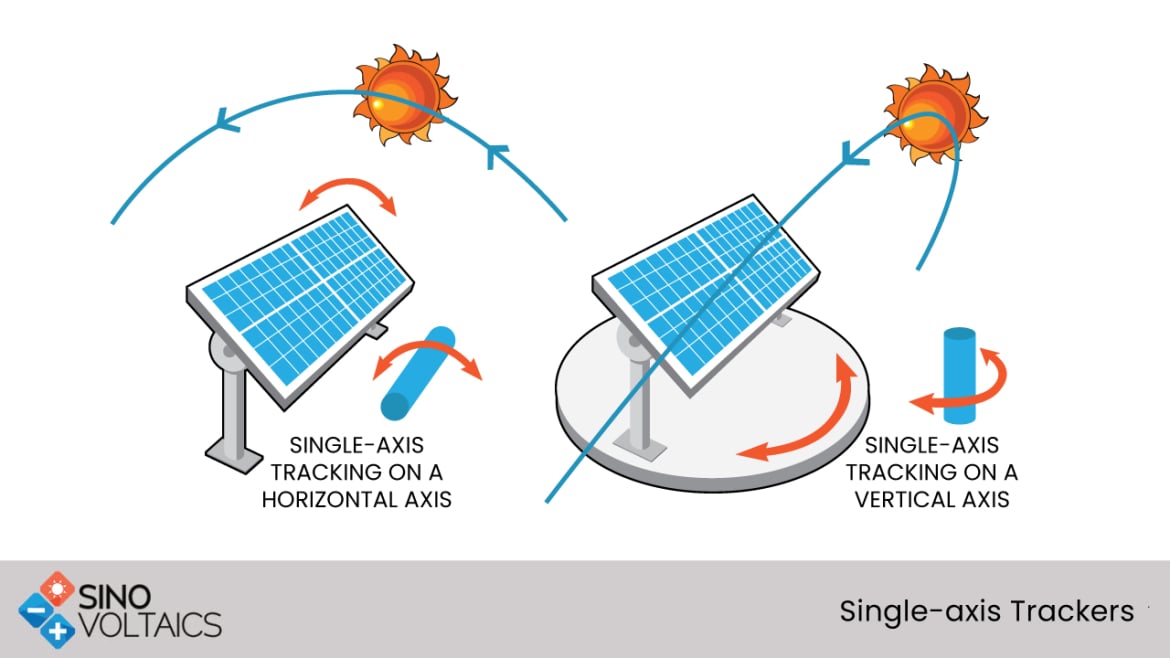
The diagram above illustrates the fundamental distinction between horizontal and vertical single-axis tracking. In the vertical configuration (right side), the panel rotates around a vertical post, making it ideal for sites where the solar tracking system must adapt to uneven terrain or where a full 360-degree sweep is mechanically advantageous.
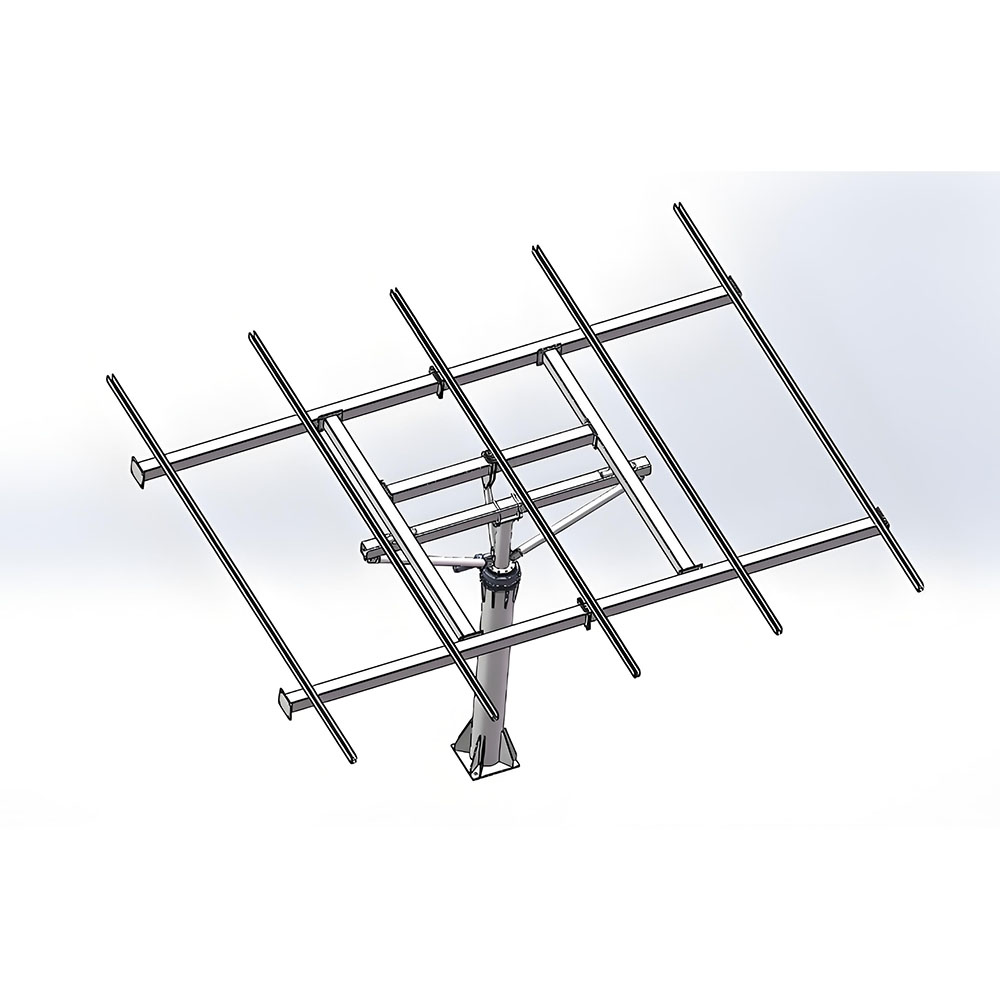
5. Dual axis solar tracker without linear actuators. We can apply this construction to be azimuth angle single axis solar tarckers.
Control System Architecture and Operating Principles
The control architecture of an azimuth-only solar tracking system balances precision, reliability, and energy efficiency. Modern controllers employ one of three strategies:
Open-Loop Astronomical Control
The most prevalent method uses embedded astronomical algorithms. The controller calculates the sun’s real-time azimuth angle based on the installation site’s GPS coordinates, date, time, and established solar position equations (such as the PSA or SPA algorithms). The motor then rotates the panel to match the calculated azimuth. This approach eliminates sensor drift and operates reliably under overcast conditions.
Closed-Loop Sensor-Based Control
In this configuration, four photodetectors arranged at 90-degree intervals (east, west, south, north) detect differential light intensity. The controller computes error signals:
- α = E − W (east-west differential)
- β = S − N (south-north differential)
The motor adjusts the tracker until both differentials approach zero, indicating optimal alignment.
Hybrid Control Systems
Дополнительно single axis solar trackers combine both approaches. Astronomical calculation provides the baseline trajectory, while optical sensors perform fine-tuning corrections. This hybrid strategy achieves tracking accuracy within ±0.5 degrees, significantly reducing cosine losses.
Backtracking and Wind Protection
A critical software feature is backtracking. When the sun is at low elevation angles (early morning or late evening), adjacent tracker rows would otherwise cast shadows on each other. The control algorithm calculates the optimal compromise angle that minimizes inter-row shading while maintaining the best possible irradiance capture.
Additionally, anemometers integrated into the control network trigger stow commands. When wind speeds exceed design thresholds (typically 15–20 m/s), the controller commands the tracker to rotate to a neutral, low-profile position to reduce wind loads and protect mechanical components.
Real-World Examples and Industry Implementations
Wattsun AccuTrak AZ-9
The Wattsun AccuTrak AZ-9 represents a commercially available azimuth angle single-axis tracker designed for residential and small commercial installations. This system mounts up to nine 60-cell modules on a single vertical pole and rotates the entire array to track the sun’s daily path. Its compact footprint and 360-degree rotation capability make it particularly suitable for installations where ground space is limited but energy yield optimization remains critical.
Zhaori ZRT-16 Tilted Single Axis System
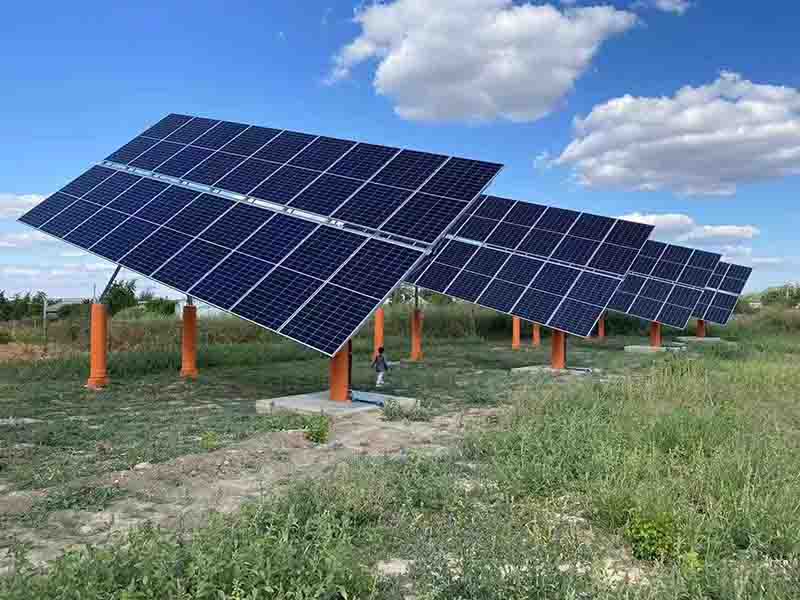
The ZRT-16 from Zhaori demonstrates how single axis solar trackers can integrate azimuth rotation with a fixed seasonal tilt. The system uses vertical pylons with orange protective coatings and rotates large module arrays around the vertical axis. This design is deployed extensively in utility-scale projects across China, where it delivers reliable performance in high-irradiance, semi-arid environments. The tilted mounting angle is optimized for the site’s latitude, while daily rotation captures the sun’s azimuth movement.
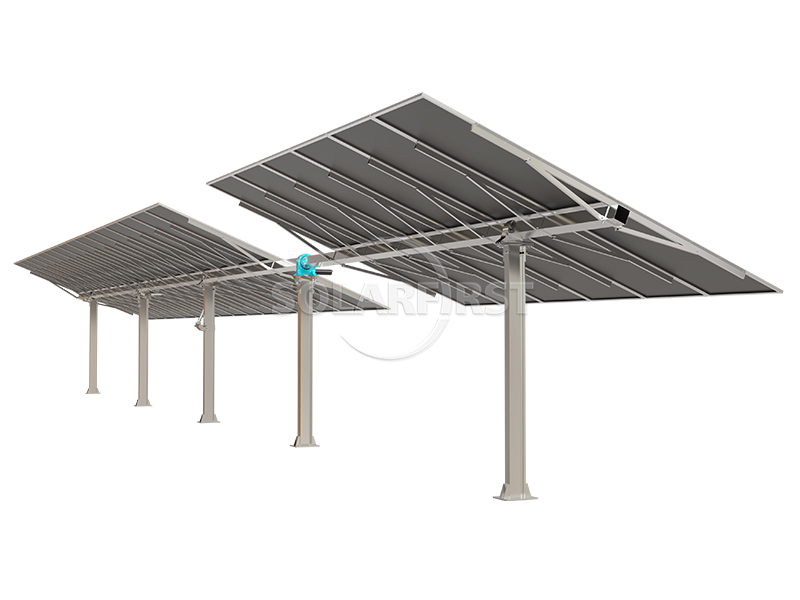
KST-1P Horizontal Single Axis Tracker (Structural Reference)
While primarily a horizontal tracker, the KST-1P system illustrates the mechanical sophistication common to modern solar tracking system designs. Its central drive mechanism, torque tube, and bearing assemblies share engineering principles with azimuth-only systems—particularly the use of slewing drives and precision gearboxes to achieve accurate angular positioning under heavy wind and snow loads.
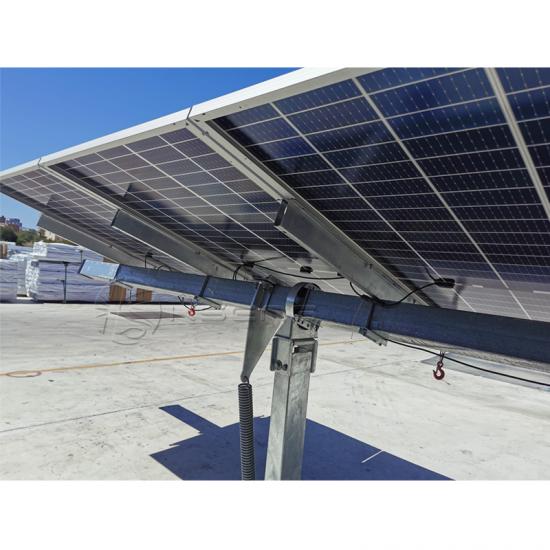
Research and Patent Implementations
Academic and patent literature reveals numerous innovations in azimuth-only tracking. One documented system employs a DC motor with a 16:1 gearbox driving a push-pull mechanism to rotate the panel around a central vertical pivot. Position feedback is achieved through a single-turn potentiometer with a 270-degree mechanical range, connected to a microcontroller’s 10-bit ADC for precise azimuth angle resolution.
Another patented design from Dromec Group features a vertically-mounted solar panel array with a central axis azimuth tracking system and tensioned linkage that enables simultaneous rotation of adjacent panels—ideal for large solar farms requiring synchronized row movement.
Performance Benefits and Considerations
Azimuth-only single axis solar trackers typically increase energy yield by 25–35% compared to fixed-tilt installations, with the greatest gains occurring during morning and evening hours when the sun is at low azimuth angle positions. The vertical rotation axis also offers installation advantages: it naturally accommodates uneven terrain without requiring graded foundations, and the 360-degree rotation capability eliminates end-of-day “unwinding” issues common to horizontal trackers.
However, designers must account for higher torsional loads on the vertical pylon and ensure that the slewing drive or rotary mechanism is properly sealed against dust and moisture. Gear backlash must be minimized—typically below 0.5 degrees—to maintain tracking accuracy during gust-induced reversals.
Заключение
The azimuth-only solar tracking system represents a mechanically elegant and economically viable solution for maximizing photovoltaic energy capture. By rotating around a vertical axis to follow the sun’s azimuth angle, these single axis solar trackers deliver substantial yield improvements while maintaining relatively simple mechanical and control architectures. From residential pole-mounted systems like the Wattsun AccuTrak to utility-scale installations such as the Zhaori ZRT-16, azimuth tracking technology continues to prove its value across diverse deployment scenarios. As drive mechanisms, control algorithms, and materials science advance, azimuth-only trackers will remain a cornerstone of efficient solar energy harvesting worldwide.