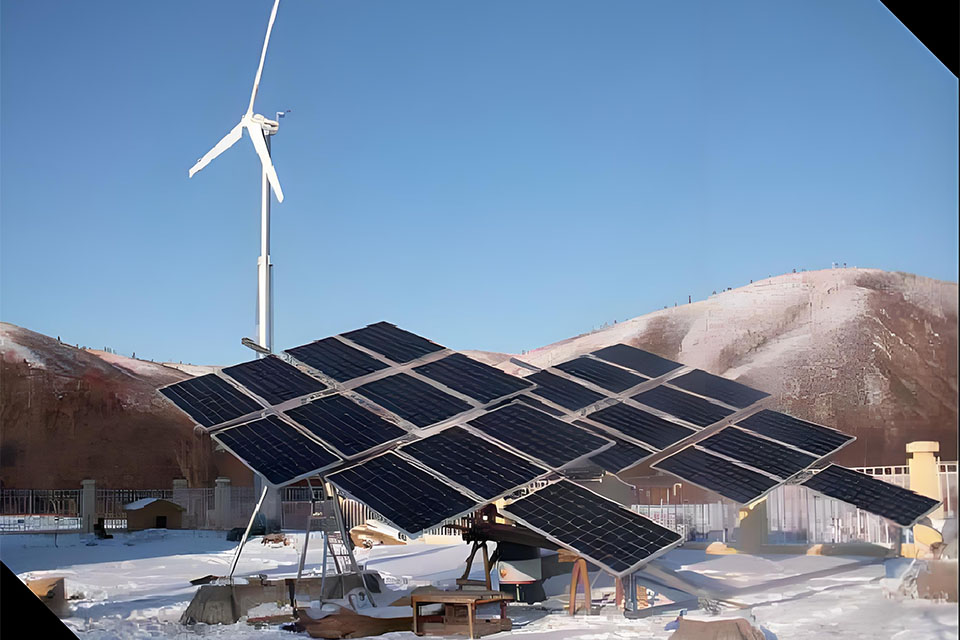
The integration of wind and solar photovoltaic (PV) energy into hybrid power systems represents one of the most promising pathways toward achieving grid stability and reducing carbon emissions worldwide. Unlike standalone renewable installations, wind and solar hybrid power systems leverage the natural complementarity between solar irradiance and wind speed patterns, effectively smoothing output fluctuations and reducing dependence on expensive energy storage. When coupled with solar tracker technology, these hybrid systems can achieve capacity factors and economic returns previously unattainable with fixed-tilt configurations.
The Science of Wind-Solar Complementarity and Power Ratio Optimization
Wind and solar resources exhibit distinct temporal distributions that create natural synergy. Solar generation peaks during midday hours when irradiance is strongest, while wind resources often intensify during early morning, evening, and nighttime periods. Research across multiple climate zones demonstrates that optimal wind-to-solar capacity ratios vary significantly by geography, ranging from 0.4:1 to 1.4:1 depending on local resource profiles.
In Northern Europe, studies indicate that configurations emphasizing wind power—approximately 70% wind and 30% solar—minimize seasonal storage requirements due to consistent winter wind resources and limited winter solar availability. Conversely, tropical and subtropical regions benefit from solar-dominant systems, with hybrid configurations requiring primarily solar energy supplemented by smaller wind contributions. In China’s diverse climate zones, optimal installation ratios largely fall between 0.4:1 and 1.4:1, with the best deployment areas concentrated in regions exhibiting strong seasonal complementarity.
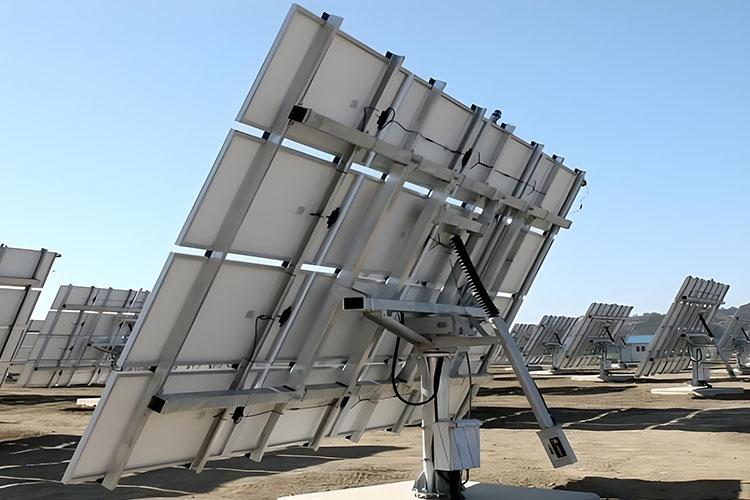
The incorporation of solar tracker systems fundamentally alters these calculations. Single-axis and dual-axis trackers can increase annual PV energy yield by 20-35% compared to fixed-tilt systems, effectively reducing the required solar installed capacity to achieve equivalent energy production. This efficiency gain allows hybrid designers to allocate greater proportional capacity to wind generation while maintaining target energy outputs, or conversely, to reduce overall system footprint and capital expenditure.
Regional Energy Demand Profiles and System Design
Northern Europe and Coastal Regions
Regions including Scandinavia, the British Isles, and Northern Germany experience high wind resource consistency but moderate solar irradiance. For these markets, hybrid systems should emphasize wind generation with solar tracker augmentation during summer months. The optimal configuration typically features 60-80% wind capacity paired with tracked solar arrays sized to capture extended summer daylight hours. These systems address heating-dominated energy demand profiles while maximizing capacity factor through wind’s winter dominance.
Mediterranean and Desert Climates
Southern Europe, North Africa, the Middle East, and Australia’s interior present intense solar resources with moderate to good wind potential. Here, solar tracker technology becomes the primary generation asset, with wind turbines providing critical evening and nighttime generation. Recommended ratios invert to 60-75% solar (with tracking) and 25-40% wind. The tracking systems’ ability to capture early morning and late afternoon irradiance extends the solar production window, directly addressing air-conditioning-driven peak demand patterns common to these regions.
Tropical Monsoon Regions
Southeast Asia, Southern China, and coastal South America experience distinct wet and dry seasons with varying cloud cover and wind patterns. Hybrid systems in these zones require careful balancing, with solar tracker arrays providing dry-season reliability and wind turbines compensating during monsoon cloud cover. Optimal ratios typically center around 50-60% solar with tracking and 40-50% wind, with system designs incorporating higher storage ratios to bridge seasonal transitions.
Continental Temperate Zones
North America’s Great Plains, Central Europe, and China’s northern provinces offer excellent wind resources alongside substantial solar potential. These regions benefit from near-balanced hybrid configurations of 45-55% wind and 45-55% solar with tracking, achieving maximum complementarity across seasonal and diurnal cycles. The tracking systems’ enhanced winter performance—capturing low-angle irradiance unavailable to fixed systems—proves particularly valuable in these higher-latitude applications.


Recommended Product Portfolio: 5-10 Configured Hybrid Systems
Based on global resource mapping and demand analysis, the following wind and solar hybrid power product configurations address distinct market segments:
1. Arctic Wind-Dominant Hybrid (2-5 MW)
- Configuration: 80% wind / 20% solar with single-axis tracking
- Target: Northern Scandinavia, Alaska, Northern Canada
- Feature: Cold-climate wind turbines with anti-icing, high-tilt tracked solar for low sun angles
2. Coastal Marine Hybrid (1-3 MW)
- Configuration: 70% wind / 30% solar with dual-axis tracking
- Target: Coastal Europe, Pacific Northwest, Japan
- Feature: Corrosion-resistant offshore-rated wind turbines, marine-environment tracked solar
3. Mediterranean Solar-Leading Hybrid (500 kW – 2 MW)
- Configuration: 70% solar with dual-axis tracking / 30% wind
- Target: Southern Europe, North Africa, Middle East
- Feature: High-temperature optimized trackers, dust-resistant wind turbines with medium hub heights
4. Desert Utility Hybrid (10-50 MW)
- Configuration: 65% solar with dual-axis tracking / 35% wind
- Target: Mojave, Sahara, Australian Outback, Atacama
- Feature: Sand-resistant tracker mechanisms, high-efficiency bifacial modules, dry-climate wind turbines
5. Tropical Island Hybrid (100 kW – 1 MW)
- Configuration: 55% solar with single-axis tracking / 45% wind
- Target: Caribbean, Southeast Asia, Pacific Islands
- Feature: Hurricane-rated wind turbines, salt-resistant tracked solar, integrated desalination loads
6. Continental Agricultural Hybrid (500 kW – 5 MW)
- Configuration: 50% wind / 50% solar with single-axis tracking
- Target: US Midwest, Ukraine, Argentina Pampas, Chinese Plains
- Feature: Agrivoltaic-compatible elevated trackers, low-noise wind turbines, irrigation load matching
7. Mountain Resort Hybrid (100-500 kW)
- Configuration: 60% wind / 40% solar with dual-axis tracking
- Target: Alpine regions, Rocky Mountains, Andes
- Feature: High-altitude wind turbines, snow-load rated trackers, heating-season optimization
8. Remote Industrial Hybrid (5-20 MW)
- Configuration: 55% solar with single-axis tracking / 45% wind
- Target: Mining operations, remote factories, desalination plants
- Feature: Heavy-duty industrial trackers, grid-forming inverters, high-penetration wind integration
9. Urban Commercial Hybrid (50-500 kW)
- Configuration: 60% solar with dual-axis tracking / 40% small wind
- Target: Commercial rooftops, industrial parks, smart cities
- Feature: Compact vertical-axis wind turbines, building-integrated tracked solar, EV charging integration
10. Equatorial Baseline Hybrid (1-5 MW)
- Configuration: 65% solar with single-axis tracking / 35% wind
- Target: East Africa, Amazon Basin, Indonesia
- Feature: High-humidity resistant trackers, low-wind-speed optimized turbines, mini-grid compatibility
The optimization of wind and solar hybrid power systems demands region-specific approaches that account for climate patterns, demand profiles, and resource complementarity. The integration of solar tracker technology elevates system performance by maximizing PV yield and extending production windows, enabling more flexible wind-to-solar capacity ratios. From Arctic wind-dominant configurations to equatorial solar-leading designs, these ten product configurations demonstrate that hybrid renewable systems—when properly engineered with tracking technology—can deliver reliable, cost-effective clean energy across every global climate zone. As markets increasingly prioritize energy security and decarbonization, hybrid systems featuring optimized wind-solar ratios and advanced solar tracking represent the definitive solution for next-generation renewable deployment.