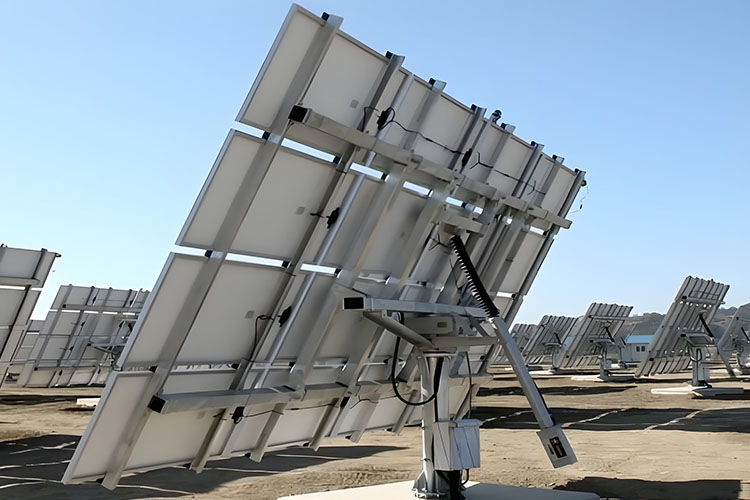
Meta description (SEO): Discover Jimmy Technology’s 12-panel dual-axis solar panel tracking system — a high-precision solar sun tracker with 360° tracking range, astronomical control, IP65 protection and 25-year design life. Full specs, advantages and application scenarios inside.
If you want to squeeze every possible kilowatt-hour out of your photovoltaic modules, a fixed-tilt mounting structure is no longer the best answer. A solar panel tracking system follows the sun across the sky so that your modules always face the light at the optimal angle — and field data consistently shows that a well-designed sun tracking solar panel array can produce 25–35% more energy per year than the same modules on a fixed rack.
In this article we take a detailed look at the 12-panel dual-axis solar sun tracker from Jimmy Technology: its mechanical design, drive and control electronics, complete technical specifications, key advantages, and the application scenarios where this solar tracker for solar panels delivers the highest return on investment.
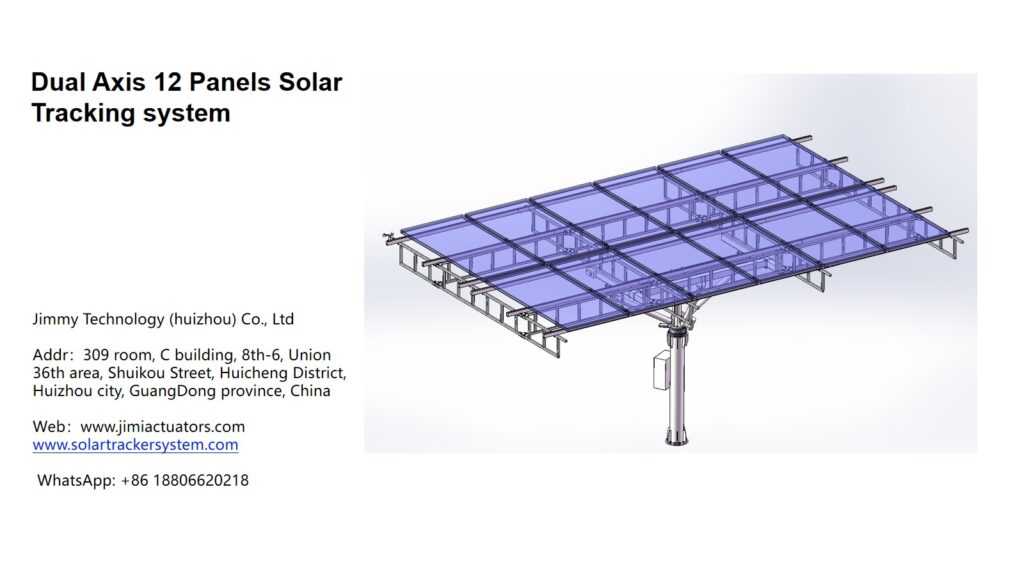
What Is a Solar Sun Tracking System?
A solar sun tracking system is a motorized mounting structure that rotates photovoltaic modules so they continuously face the sun. Unlike a fixed bracket, which is locked at one tilt angle chosen as a yearly compromise, a tracker moves with the sun’s daily and seasonal path.
There are two main categories of sun tracking system on the market:
- Single-axis trackers rotate around one axis (usually north–south) and follow the sun from east to west. They are common in utility-scale plants but leave seasonal altitude gains on the table.
- Dual-axis trackers — like the Jimmy Technology 12-panel model — rotate on both the azimuth and elevation axes. The module plane stays nearly perpendicular to the sun’s rays from sunrise to sunset, in every season. This makes the dual-axis solar sun tracker the highest-yield option per installed module, especially at higher latitudes and in distributed-generation projects where every square meter counts.
Mechanical Design and Construction Details
The 12-panel solar panel tracking system is built around a single heavy-duty column topped by a torque-frame structure that carries 8 to 12 photovoltaic modules of 500–650 W each (module size up to 2300 × 1130 mm). The total bracket area is approximately 30 m², giving each tracker a rated capacity of up to 7.8 kWp when equipped with 650 W modules.
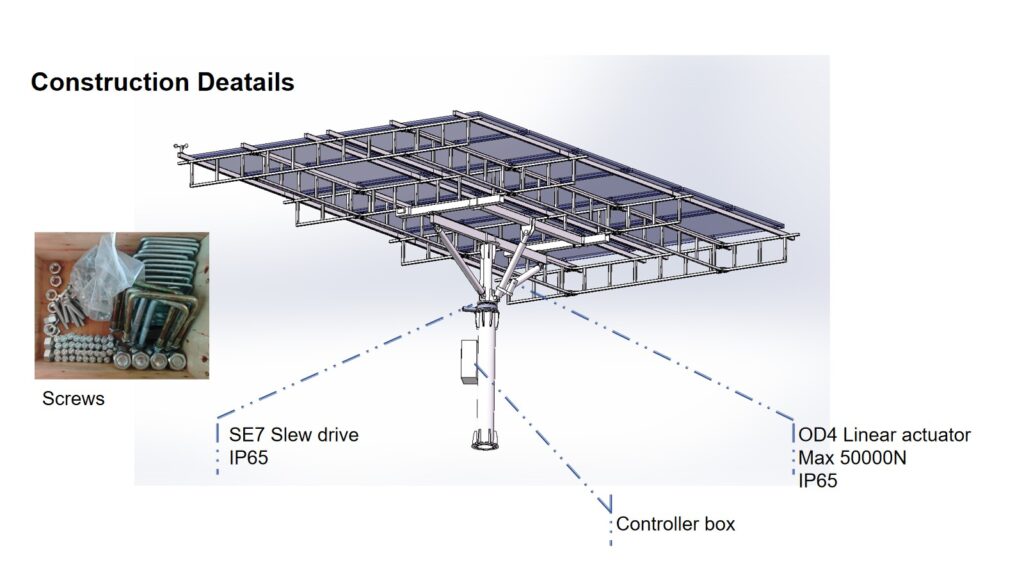
Key mechanical and drive components include:
- SE7 slew drive (IP65) for azimuth rotation. The enclosed worm-gear slew drive provides high holding torque, self-locking capability and smooth 360° rotation, so the array stays exactly where the controller puts it — even under wind gusts.
- OD4 linear actuator (max. 50,000 N, IP65) for elevation (tilt) movement. This heavy-duty electric linear actuator sets the tilt angle within a 30° range and holds it against gravity and wind loads without consuming holding current.
- Q235 structural steel throughout the torque tube, purlins and column. All steel parts receive painting or hot-dip galvanizing anti-corrosion treatment, enabling a design life of 25 years or more in outdoor environments.
- Controller box mounted on the column, housing the tracking controller, sensor interfaces and power electronics.
- Galvanized fasteners and U-bolts supplied as a complete kit, packed in a wooden box with bubble film for safe international shipping.
The complete structure weighs over 600 kg and is engineered to operate normally in winds up to 27 m/s, with an optional wind-protection mode that automatically moves the array to a safe stow position when an anemometer detects dangerous gusts.
Dimensions and Footprint
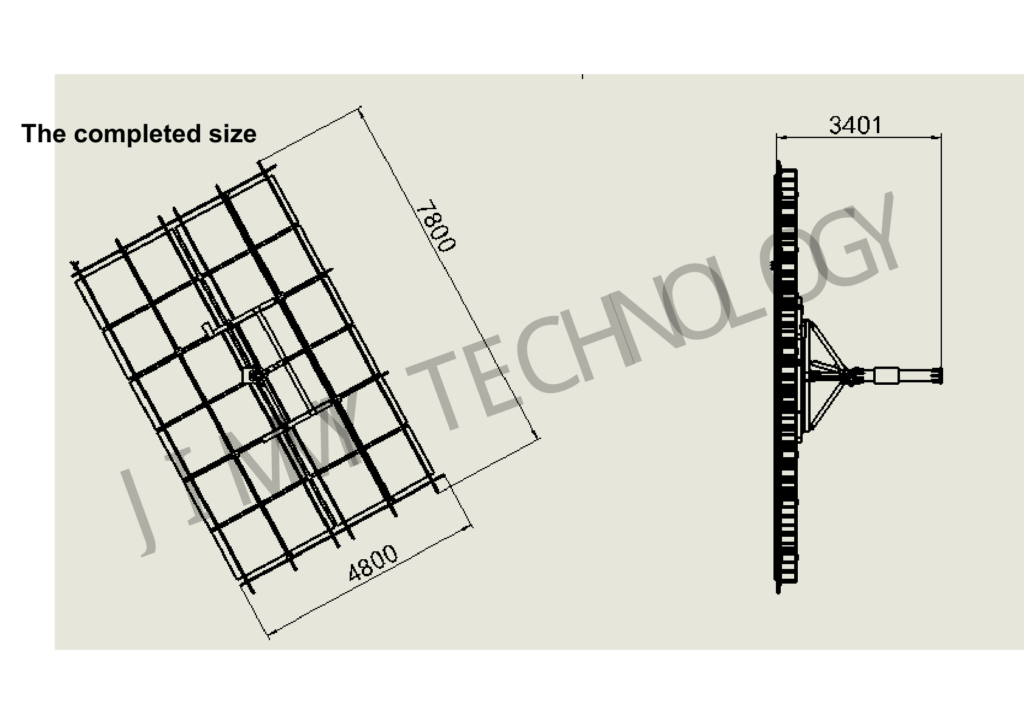
The completed tracker measures 7,800 mm × 4,800 mm in plan view, with a total height of approximately 3,401 mm. The single-pole foundation design means the ground footprint is extremely small — only the column base requires a concrete foundation — so the land between rows remains fully usable for farming, grazing or vegetation.
Smart Control: How the Sun Tracking Solar Panel Follows the Sun
At the heart of this solar sun tracking system is an astronomical-algorithm controller. Instead of relying only on light sensors (which can be fooled by clouds, haze or soiling), the controller calculates the sun’s exact position from the date, time and geographic coordinates, then drives the slew drive and linear actuator to match it. Tracking accuracy is ≤ 5°, and a closed-loop angle sensor provides real-time angle feedback so the controller can verify and correct every movement.
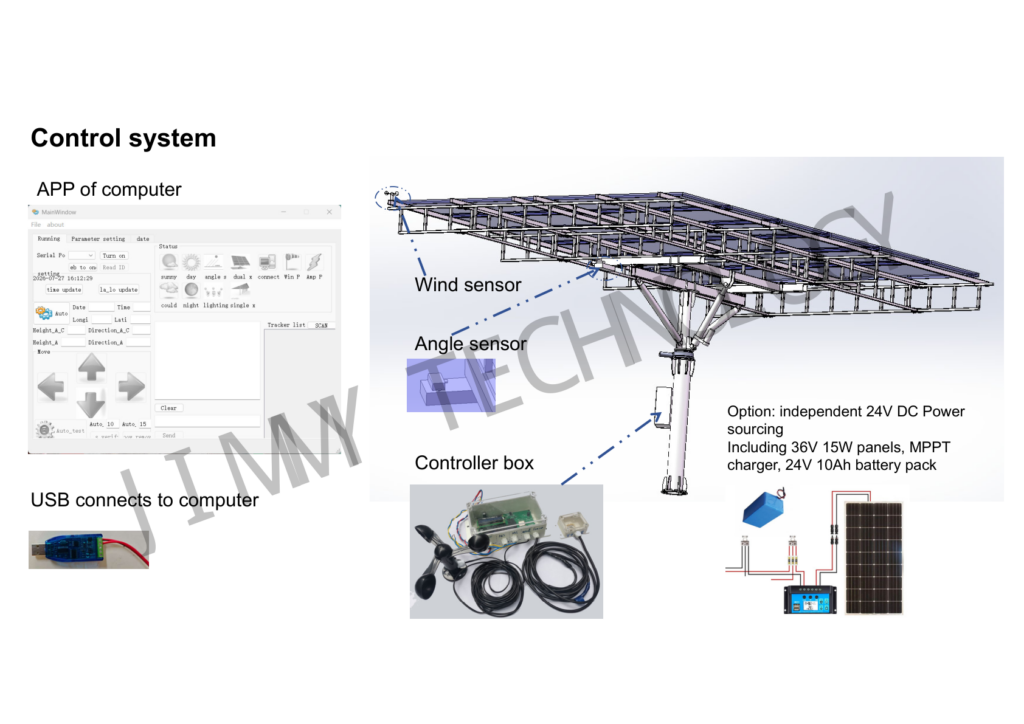
The control package includes:
- Astronomical control method with back-tracking support to avoid row-to-row shading in multi-tracker arrays.
- Wind sensor (anemometer) for automatic wind-stow protection (optional).
- Angle sensor for closed-loop position feedback.
- Computer APP connected via USB/RS485: operators can set parameters (longitude, latitude, date, time), run auto-tests, jog the tracker manually, and monitor status such as sunny/cloudy, day/night, single-axis/dual-axis mode.
- RS485 communication as standard, with optional GPS positioning y remote monitoring functions for unattended sites.
- Limit protection and data protection built in as standard.
- 24 V DC input voltage, with an optional independent power supply kit: a 36 V 15 W solar panel, MPPT charger and 24 V 10 Ah battery pack, allowing the tracker to run completely off-grid.
Full Technical Specifications
| Parámetro | Especificación |
|---|---|
| Control method | Astronomical algorithm |
| Tracking accuracy | ≤ 5° |
| Back tracking | Sí |
| Tracking range | 360° (azimuth) |
| Tilt angle | 30° |
| Normal wind resistance | 27 m/s |
| Angle feedback | Yes (angle sensor) |
| Operating temperature | −40 °C ~ +70 °C |
| Input voltage | 24 V DC |
| GPS positioning | Opcional |
| Remote function | Opcional |
| Communication | RS485 |
| Wind protection | Optional (with wind sensor) |
| Limit protection | Sí |
| Data protection | Sí |
| Standard | GB/T 29320-2012 |
| Protection degree | IP65 |
| Module quantity | 8–12 pieces |
| Module power | 500–650 W |
| Module size | 2300 × 1130 mm |
| Bracket area | ≈ 30 m² |
| Material | Q235 steel |
| Anti-corrosion | Painting / hot-dip galvanizing |
| Vida útil del diseño | ≥ 25 years |
| Peso | ≥ 600 kg |
| Package | Wooden box with bubble film |
Key Advantages of This Solar Tracker for Solar Panels
1. Maximum energy yield per module. Dual-axis tracking keeps the modules near-perpendicular to sunlight all day. Compared with a fixed mounting structure, the same 12 modules can generate roughly 25–35% more electricity annually — in many distributed projects this means the tracker pays for itself through extra generation alone.
2. Proven, robust drive train. The SE7 slew drive and 50,000 N OD4 linear actuator are industrial-grade components with IP65 protection, self-locking gearing and high holding torque. There are no hydraulic fluids to leak and no chains to stretch, so maintenance is minimal.
3. All-weather intelligence. Astronomical tracking with angle feedback works accurately even on cloudy days; the optional wind sensor triggers automatic stowing before storms; limit protection and data protection guard against misoperation and parameter loss.
4. Built for 25+ years outdoors. Q235 steel, hot-dip galvanizing or painting, IP65 enclosures and a −40 °C to +70 °C operating range make this sun tracking solar panel mount suitable for deserts, coastal areas, high-altitude plateaus and cold northern regions alike.
5. Small land footprint. One column, one foundation. The 7.8 m × 4.8 m array floats above ground, leaving the land below and between rows available for agriculture — ideal for agrivoltaic (agro-PV) projects.
6. Off-grid capable. With the optional 24 V DC solar power kit (36 V 15 W panel + MPPT charger + 24 V 10 Ah battery), the tracker operates independently of any external power source — perfect for remote pumps, monitoring stations and islanded microgrids.
Installation: Simple Three-Step Foundation
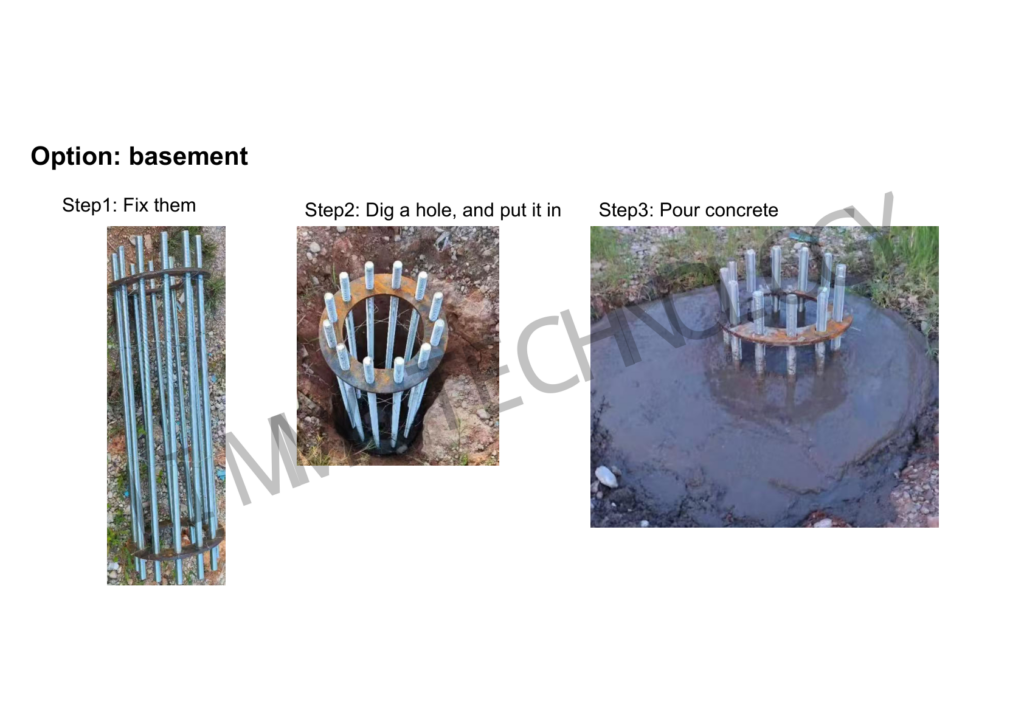
Installing the tracker requires only a single concrete foundation:
- Fix the anchor bolts into the supplied cage template.
- Dig the hole and lower the bolt cage into position.
- Pour the concrete and allow it to cure, then erect the column, torque frame, drives and modules.
Because all parts are pre-engineered and pre-drilled, a trained crew can complete a tracker quickly with standard tools — no welding or specialized machinery required on site.
Application Scenarios
Thanks to its 8–12 module capacity, this solar panel tracking system sits in a sweet spot between residential mounts and utility-scale tracker rows. Typical applications include:
- Distributed commercial & industrial (C&I) rooftop and ground projects where space is limited and maximizing yield per module is critical.
- Agrivoltaics / agro-PV: crops, orchards and grazing continue underneath and between trackers while the high-clearance array follows the sun.
- Solar water pumping systems for farms, ranches and irrigation — the optional independent DC power kit makes fully autonomous operation possible.
- Remote off-grid power stations for telecom base stations, weather and monitoring equipment, border posts and islands.
- Fishing–solar complementary (floating-adjacent) and pond-side plants where land is scarce and single-pole foundations minimize civil works.
- Demonstration and research installations, universities and test yards that need a controllable, instrumented dual-axis platform.
- High-latitude regions where the sun’s low winter elevation makes dual-axis tracking significantly more valuable than single-axis designs.
Conclusión
A high-quality solar sun tracker is one of the most cost-effective ways to increase the output of a photovoltaic array without adding a single extra module. The Jimmy Technology 12-panel dual-axis sun tracking system combines an astronomical controller with ≤ 5° accuracy and closed-loop angle feedback, an IP65 SE7 slew drive and 50,000 N linear actuator, 27 m/s wind resistance with automatic stow, hot-dip galvanized Q235 steel construction and a 25-year design life — all in a compact single-pole footprint of 7.8 m × 4.8 m.
Whether you are building an agrivoltaic farm, an off-grid pumping station or a high-yield distributed plant, this solar tracker for solar panels is engineered to deliver more kilowatt-hours, year after year.
Contact: Jimmy Technology — Web: www.jimiactuators.com / www.solartrackersystem.com · WhatsApp: +86 188 0662 0218